
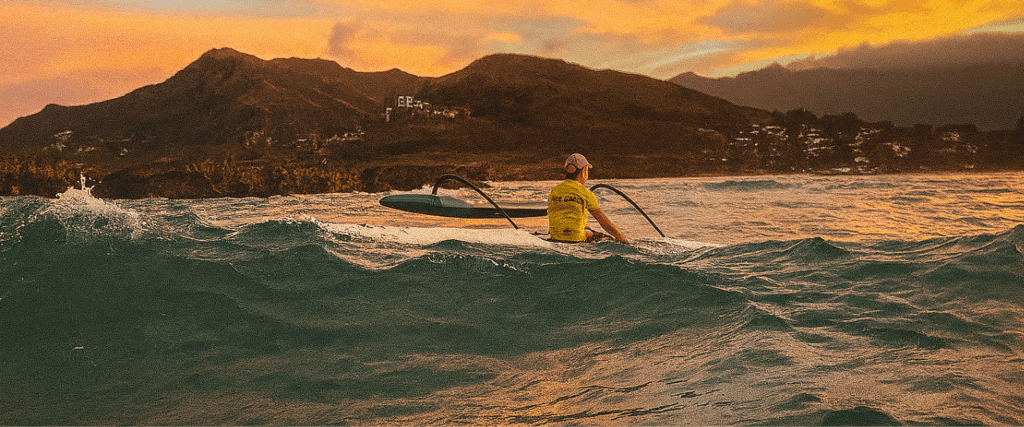
Speed doesn’t come from fitness alone — it comes from skills.
I trained hard for my first OC1 races — and still got dropped as soon as the water got messy.
In my first ever OC1 race in Hong Kong, I watched the backs of the other women get smaller and smaller as soon as we left the flat water of Deep Water Bay.
They were using small runners and bumps I didn’t even know were there.
I just kept paddling at a steady rate — totally unaware of the opportunities around me.
Same thing in my first OC1 race in Hawaiʻi a few years later.
It was a triangle course. I started strong — even ahead of a few women — but as soon as the water got messy (waves from multiple directions), they pulled away.
By the downwind section, I was at the very back. By the finish, no one was in sight.
I didn’t know what I didn’t know.
I thought I just needed more training.
But I was already training hard — and still getting dropped.
OC1 isn’t just about fitness. It’s a complex, skills-heavy sport.
I had strength. I had good technique. But I didn’t know how to use the ocean.
I didn’t know that a well-timed increase in stroke rate + strategic steering could help me ride bumps.
I didn’t know that leaning on my ama was making me slower and more unstable — and that I could learn to sit up, use my legs and a brace stroke for stability.
When I asked more experienced paddlers how to improve, most just said:
“Just feel it.”
“Spend more time on the water.”
Helpful? Not really.
Eventually I learned:
👉 It’s not just about feeling.
👉 It’s not just time on the water.
👉 It’s about developing skills.
Here’s the system I use — and coach:
- Technique = How you apply power through the stroke.
It’s rotation, leg drive, posture, and a clean catch that connects your body to the water. Great technique makes every stroke count. - Skills = How you respond to conditions.
Steering, timing, decision-making, and adapting to the ocean in real time — that’s skill. - Training = What builds your engine.
Strength, endurance, and speed come from targeted sessions off and on the water.
Most paddlers work on one or two of these.
But to get faster in downwind, you need all three — especially skills.
The Shift
Once I started focusing on ocean-specific skills, everything changed.
I worked on my balance and stability.
I learned to vary my stroke rate to match the water.
I stopped paddling straight into every wave and started learning how to steer to stay on waves, and when to go around them,
➡️ And I didn’t wait for “perfect” downwind conditions to practice.
That was a big turning point for me:
I trained these skills, even on flat water.
When real conditions showed up, I was able to apply what I’d already worked on.
The Problem Most Paddlers Face
Here’s why many women hit a plateau
Big-water days don’t happen often enough.
Events like the Gorge or Molokabra are only once a year.
And not everyone has a group to go with or access to ideal downwind.
So what happens?
👉 Most paddlers train for fitness… but skip skills.
👉 They get stronger, but don’t get faster.
👉 They’re working hard, but still get dropped when the conditions get technical.
The Good News
You don’t need huge wind or perfect surf to train ocean skills.
You just need the right drills — and the right mindset.
It’s what I call:
Train hard moves in easy water.
Flat water gives you space to learn:
- How to change tempo
- How to get off your ama
- How to use your brace stroke
- How to prepare your body to catch and link waves
These are the skills that translate to downwind confidence and speed.
4 OC1 Surfing Skills You Can Build on Flat Water
You don’t need perfect conditions to work on downwind skills.
Here are four things you can train now — even in calm water.
🔹 1. Acceleration
Catching a wave takes more than strength — it takes a quick burst of speed.
Practice:
• Short sprints (15 strokes or less) at your fastest possible tempo.
• Focus on a clean catch, leg drive, and staying upright.
• This trains your body to react fast enough to catch runners when they appear.
🔹 2. Tempo Changes
Staying on a wave often depends on knowing when to slow down, and when to punch it.
Practice:
• Rotate between 5 slow strokes (around 50/min), 5 fast (70–80/min), then 5 slow again.
• Repeat until your transitions are smooth and controlled.
🔹 3. Get Off the Ama
Leaning on your ama slows you down and makes you less stable in ocean conditions.
Practice:
• Paddle with less weight on the left side – try to make your weight even.
• Focus on sitting centered in your canoe, pushing through your feet for balance.
• Combine this with acceleration and tempo drills so you learn to move fast without collapsing into your ama.
🔹 4. Brace Stroke
Your brace stroke gives you confidence, especially on the right side, where paddlers often hesitate.
Practice:
• Start and finish each session by flying your ama. This trains your reflex to stop leaning left and use your brace instead.
• Lean out, apply pressure to your paddle, and learn how to take a stroke without leaning on the ama,
• Use your paddle (and feet) for stability — not your ama.
When the ocean gets messy, your brace stroke keeps you upright.
But more than that, it helps you:
👉 Take a full stroke without hesitation
👉 Trust your center of gravity
👉 Stay fast and stable, even when your ama lifts
This one skill alone can transform how you feel in rough water.
📹 How to do a brace stroke and stop a huli on your OC1
🧠 Build your OC1 surfing skills on flat water, and you’ll see real gains in speed and confidence on downwind runs.
📚 Want to go deeper?
If you’re building OC1 downwind skills, these guides pair perfectly with what you just read:
- ✅ Train OC1 Surf Skills on Flat Water
Drills for acceleration, tempo, and ama control — even on calm days. - ✅ Sharpen Your Downwind Skills by Practicing on Flat Water
How to prep your body and mind for ocean conditions — without waiting for wind.
🔥 Want hands-on coaching? Join me for one of our Downwind Skills Intensive for women OC1 paddlers. We’ll train: Technique, skills, and fitness — separately and with intention.