
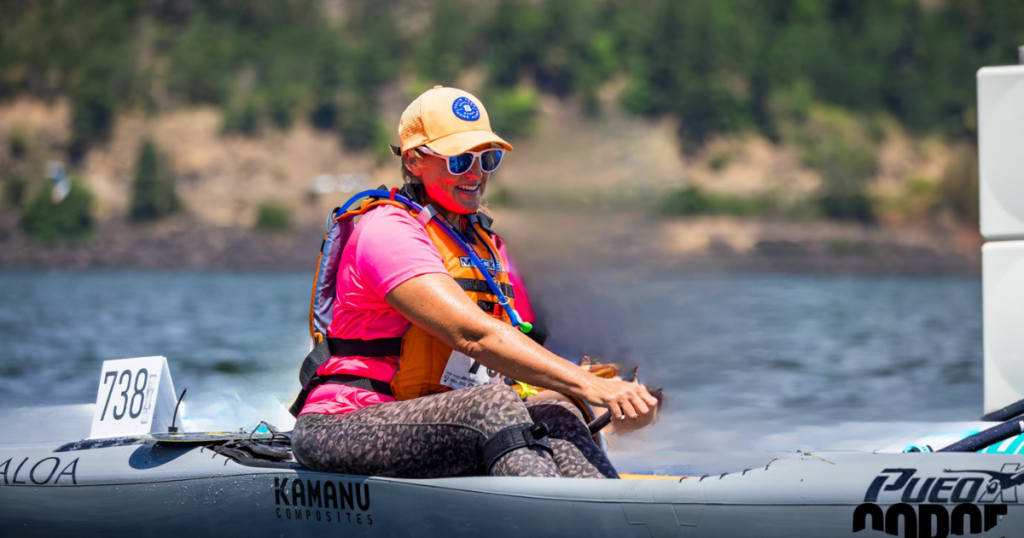
When OC1 doesn’t feel like a workout
There’s a training problem in OC1 that isn’t being addressed — and it’s leading to training without improvement.
As a coach, it’s my job to help paddlers improve, and I see this problem come up often: the inability to get heart rate up when paddling OC1.
Strong, fit women get in an OC1 and feel like they can’t access the same effort they can in other sports.
“My heart rate doesn’t get as high as it does when I run or bike.”
“I try to work hard, but I’m not that tired afterward.”
“OC1 doesn’t feel like a workout.”
There’s a gap between the effort you’re trying to generate and what your body is actually able to produce in an OC1. You’re putting in the work — but the effort isn’t translating into higher heart rate or sustained intensity.
YOU’RE NOT WRONG
If this has been your experience, you are not alone. I hope to help you make sense of it so you can take steps to address it.
OC1 is not just another cardio modality. It’s a technical, full-body sport. You can be fit. You can be strong. You can be willing to work hard — and still struggle to create the kind of effort that drives up heart rate and allows for fitness gains to occur.
The issue isn’t motivation or desire.
It’s that the muscles you need aren’t being recruited fully or consistently.
Before you change programs or question your fitness, it helps to understand what training is meant to do and what the challenges of OC1 are that get in the way of being able to get the intensity you can from running or other sports.
WHAT TRAINING IS SUPPOSED TO DO
Training is meant to create specific adaptations.
You stress the body in a particular way, and over time it responds by getting stronger, fitter, or more capable in that area.
But adaptation only happens when a real stimulus is present.
That stimulus depends on a few things happening at the same time: the right muscles have to be recruited, effort has to be generated and sustained — not just once, but repeatedly — and there has to be appropriate recovery between efforts.
If any one of those pieces is missing, the intended adaptation doesn’t occur.
WHY OC1 IS UNIQUELY CHALLENGING AS A TRAINING ENVIRONMENT
OC1 is a complex, full-body water sport. You’re managing a paddle, a canoe, and the elements at the same time.
Learning how to recruit the right muscles, in the right sequence, is not automatic in this sport. Many paddlers don’t learn how to consistently access and coordinate those muscles.
Waves, boat wake, backwash, wind, and chop make it even harder to consistently load the paddle and recruit muscle the way you can in a stable environment (such as on an erg or running on a flat road).
THE REAL LIMITER
If you can’t consistently recruit muscle, you won’t be able to generate the effort a workout is designed to produce.
In OC1, that inconsistency usually comes from technique limitations, which are then compounded by the instability of the canoe and the conditions — not from lack of trying.
When effort can’t be generated or repeated, true interval work never happens. And without both sufficient intensity and appropriate rest, the intended adaptation doesn’t occur.
This is why even well-designed programs often don’t work in OC1.
HOW THIS USUALLY SHOWS UP
This is usually how it presents.
“OC1 just doesn’t let me work hard the way other sports do.” “I can’t get my heart rate up, or I can’t keep it there.” “I try to do intervals, but they don’t really work.”
The missing intensity means training sessions all end up feeling about the same.
Heart rate never reaches its potential, and the stimulus never really changes. The training lacks real separation between hard days and easy days.
This is when training becomes exercise, instead of what an athlete needs to get fitter — stress plus rest.
From a coaching lens, this is not training, and from the paddler’s lens, it feels like not much changes across training days.
WHY THIS MATTERS
Many of us paddle for fun, for health, for community, and for time in nature.
Some of us also love the challenge, the excitement, and the accountability that comes with racing or training toward a goal.
All of that matters. But enjoyment alone doesn’t create adaptation. Whether your goal is performance or long-term health, the body only adapts when it is sufficiently stressed.
Cardiovascular and muscular systems adapt in response to stress in the form of intensity. Without that stress, the experience may still be enjoyable — but the adaptation you’re working for doesn’t happen.
The body doesn’t get what it needs to improve — and performance reflects that.
WHAT TO DO WHILE OC1 ISN’T PROVIDING THE STIMULUS
Technique and skill should be trained as separate modalities. Technique is how you move – the muscles you recruit to power the stroke. By skill I mean your ability to handle the canoe and the conditions—balance, stability, control, timing—so you can actually apply your technique and power.
Strength matters a lot. Lifting weights to develop the muscles needed to apply force makes it easier to generate real power once technique improves.
Cardio conditioning matters too. Use controlled environments to train cardiovascular output when OC1 can’t yet provide it.
And remember: interval training only works when both intensity and rest are present. Without both, it’s just more steady effort which is exercise, not training.
USING CROSS-TRAINING STRATEGICALLY
Swimming, rowing, or the ski erg can be useful because they let you train upper body effort in a stable setting.
Running or biking work too. The goal isn’t to perfectly match paddling — it’s to be able to generate and hold real effort with intervals.
Choose cross-training that has a low risk of injury, is easy to start and repeat week after week.
LEARNING TO CONTROL EFFORT
Part of this is simply learning what different levels of effort actually feel like — and how to reproduce them.
If you can’t hold a steady low intensity without your heart rate drifting up, pacing and control likely need work.
If you can’t stay in a high zone for the duration of an interval, the capacity isn’t there yet.
If your stroke rate or cadence falls apart under effort, tempo and consistency are limiting factors.
And if you don’t know what your heart rate is doing, you’re missing a tool that can help you figure out what stimulus you’re actually creating.
CLOSING THE LOOP
Conditioning can be built off the water, in environments where you can get your heart rate up and effort and rest can be controlled.
Strength supports your ability to apply force once technique allows it.
Muscle recruitment is developed on the water through deliberate technique and skill work.
As technique and skill improve, higher intensity training in the OC1 becomes more available.
Over time, the training you do off the water and what you can do on the water begin to intersect. The capacity you build in controlled training starts to show up in the canoe — and OC1 finally becomes the workout you want it to be.