
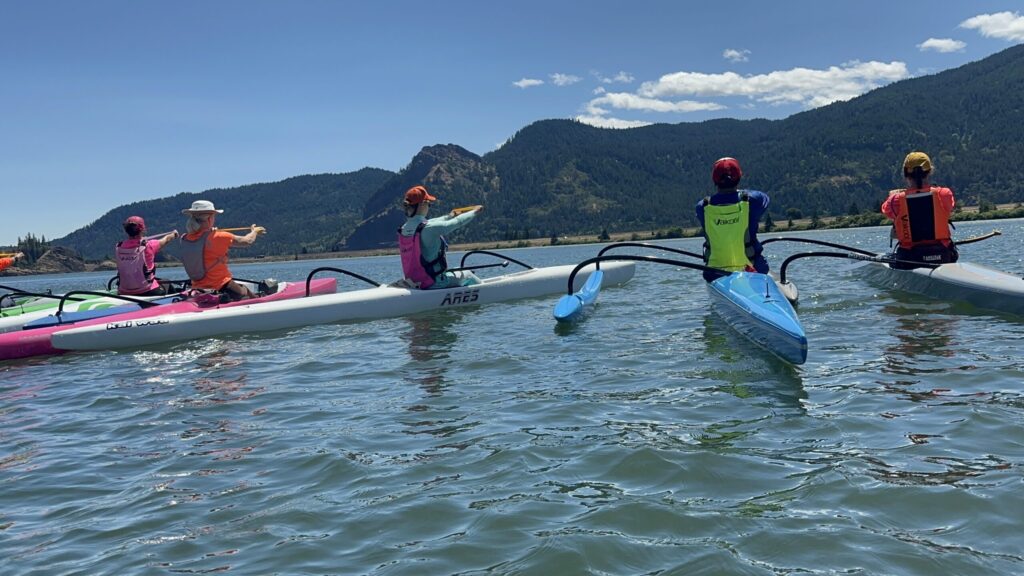
When everyone else is smashing every session, it’s tempting to think more effort is the only answer.
But the real gains come from training the whole picture — technique (your stroke), skills (how you use the water and manage your canoe), and training (how you develop your strength and conditioning — aka your fitness) — in balance.
I can remember my first solo Ka’iwi Channel crossing on an OC1 in 2009 — 6 hours and 57 minutes, 22,000 strokes, and almost no wind to help me along. The channel was flat and slow, the kind of conditions that test your patience and your body.
I kept my mind on one stroke at a time: Sit up. Shoulders back. Connect through the heel, use your legs. Over and over, thousands of times, until I reached the finish.
That single-focus mindset worked on race day — but it was built on months of balanced training, not just endless intervals.
Looking back, what got me there wasn’t anything I did on race day.
It was months of training — technique, strength, and conditioning — repeated over and over.
Consistency plus time equals results.
The Three Categories
Over the years, the more I coached, the more races I did, the more injuries I worked through, the more I tinkered to find speed… the clearer it became.
I started to see which muscles really power the stroke, how alignment changes everything, and what common mistakes lead to injuries and imbalances.
And I saw the same patterns in the women I coached.
Even so, in my first few seasons racing OC1 in Hawai‘i, I fell into the same trap many paddlers do — thinking the only thing I needed to do to get faster was get stronger and fitter.
I trained hard. I smashed intervals. And eventually, I plateaued.
That’s when I realized my story wasn’t unique — most paddlers hit this wall when they focus only on fitness and skip the other pieces.
Your performance depends on three categories:
- Technique – how your body moves
- Skills – how you use the water and manage your canoe
- Training – how you develop your strength and conditioning — aka your fitness
The mistake? Most paddlers focus on the third one — smashing intervals and building fitness — but skip training how they move or how they handle their canoe when conditions get tough.
When results stall, they ask, Am I doing enough? Should I add more intervals?
Effort isn’t the issue. You get faster by working all three, consistently, over time.
That’s where Consistency + Time = Results really matters.
Why This Matters for Women
Our bodies won’t let us ignore mechanics for long.
Most of us didn’t grow up paddling or lifting weights.
We come to this sport later, often without years of building the kind of strength paddling demands — lat strength from pull-ups, pec strength from bench presses, back strength from deadlifts.
Without that base, it’s easy to overload smaller muscles and joints instead of driving from the big ones.
On top of that, women tend to be more slow-twitch dominant.
We’re born for endurance, not explosive speed — but racing demands both.
To hold a high paddling cadence, you need to recruit fast-twitch muscle fibers.
And to paddle that hard without breaking down, you need the strength and mechanics to match.
When alignment is off, we feel it in our joints.
When technique fades, our bodies compensate in ways that lead to overuse and imbalance.
The good news? The payoff for building solid technique and skill is huge.
With the right mechanics, every bit of strength and conditioning work transfers better into the boat — giving you more speed and less wear and tear.
The Cost of Skipping This Work
It’s not just that you don’t improve. You actually move backwards.
You get stronger, but not more efficient.
You paddle harder, but not faster.
Your body absorbs more force, but doesn’t use it well.
You hit a plateau — or worse, an injury — and you’re left wondering why your training “isn’t working.”
This is how paddlers burn out.
Not from doing too much, but from doing too much of the wrong thing.
What It Looks Like in a Week
This isn’t just theory — here’s how it plays out in real training.
You don’t need more hours. You need more balance.
- Technique: 20 minutes before or after your paddle. Or one focused session per week.
- Skills: Add surf skills or balance work into your warm-up. Or replace one interval session with an open-water skills session.
- Training: Hard intervals, strength in the gym, or endurance paddles — these don’t go away. But now they’re supported.
The formula is simple: work all three categories consistently, over time.
That’s what produces results on race day.
When Everyone Around You Just Wants to Smash
Culturally, we’re taught to go harder.
To prove ourselves by how much we can suffer.
You show up at practice, and everyone wants to crush every interval.
Rest days feel lazy. Technique sessions feel like a “nice to have,” not the real work.
But if you want to stand out, you have to do something different than the average paddler.
Most people won’t train technique.
Most won’t spend time on skill.
They’ll keep grinding. And when they plateau, they’ll just grind harder.
That’s your competitive edge.
Let them.
You can take a different path.
One that works with your body, not against it.
The results might not show up in a single session, but give it time and you’ll feel the shift:
- more connection
- more speed
- more confidence
- fewer injuries
Hard training only works when it’s built on the right foundation — and when you give it time.
That’s why Consistency + Time = Results isn’t just a formula… it’s the whole game.
So next time you’re wondering if you’re training hard enough, ask yourself:
Am I putting time into the whole picture — technique, skills, and training — and doing it consistently over time?