
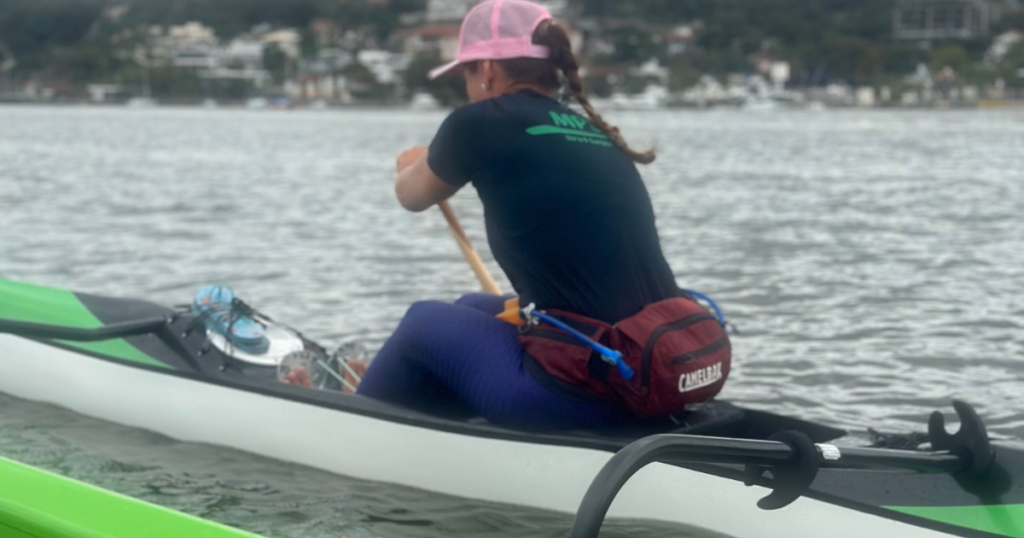
One of the privileges of coaching — whether in groups, one-on-one, in person, or online — is that I get to hear honestly about the challenges paddlers are experiencing in their OC-1 paddling.
Sometimes the conversation is about reading the water, confidence in conditions, or what happens when someone falls off the back of a wave.
Other times the challenge sounds more like this:
“I feel like my OC-1 results don’t reflect what I can do in an OC-6.”
“I don’t understand why I can’t hang with my teammates in OC-1.”
“My friend got so much faster this past year, and I stayed the same.”
Underneath all of it is the same desire:
I want to get better.
I feel like I should be able to keep up with the faster women.
Often the issue is a misunderstanding of what OC-1 actually requires.
Many paddlers assume that if they are strong in another paddle sport, like OC6 or dragon boat, that ability will naturally transfer into OC-1. But paddling isn’t all the same.
You can be very fit, very strong, and very experienced in other paddle craft and still feel surprisingly limited in OC-1.
OC-1 asks something different from the athlete.
Unlike team boats like OC-6 or dragon boat, you are responsible for everything — the balance of the canoe, steering and navigating to stay on course, how power is applied to the water, how the boat accelerates, and how it moves through changing conditions.
There is no crew or steersperson to stabilize the boat or carry speed when you’re struggling.
That makes OC-1 a highly technical craft. So often I see women get frustrated with their results but they are missing the point that OC-1 is complex and it takes dedicated time to develop.
Treating OC-1 as just another paddle session layered on top of other training often leaves paddlers frustrated when they don’t automatically see results.
OC1 IS ITS OWN SPORT
When we start looking more closely at why results differ between paddlers, the conversation usually shifts to what actually creates speed in OC-1.
Speed in OC-1 isn’t random. It’s built over time through a combination of fitness and technical skill — and in an OC-1 those things have to be developed by the individual paddler. You may experience pieces of them in an OC6 or dragon boat, but they don’t automatically transfer.
That includes:
- The ability to accelerate repeatedly while dealing with instability
- The strength to hold power in wind or open water while steering through conditions
- Stroke rate control and endurance
- Managing conditions instead of simply surviving them
- Controlling the ama instead of saving it
- Interval training in an OC-1 that develops speed and power
- Developing self-awareness and athleticism using tools — such as heart rate, a metronome, or monitoring your speed on flat water — to track and measure progress over time
These things develop gradually through time spent in the canoe learning how it moves and how your body interacts with it and developing your ability to go fast.
There is no magic solution. It’s the result of years of consistent time in an OC1. It’s not glamorous and it doesn’t happen quickly.
But it’s how paddlers slowly become faster, more efficient, and more comfortable in OC-1.
COMPARING OUTCOMES WITHOUT COMPARING INPUT
When women describe to me what their training week currently looks like, patterns usually appear.
The issue usually isn’t that athletes aren’t training. It’s that very little of that training is sports specific or actually dedicated to developing OC-1.
A typical week might include multiple sports like OC-6 practices and/or dragon boat training, F45 or CrossFit, circuit classes, running or swimming, yoga, and the occasional OC-1 paddle. The athlete is working hard and the schedule is full.
OC-1 often ends up around the edges of the week instead of being the center of it.
And then the question comes up:
“Why am I not as fast in OC-1 as the other women?”
Often the answer is uncomfortable but simple.
Many paddlers are effectively trying to train two paddle sports at the same time — dragon boat and OC-1, or OC-6 and OC-1.
So often OC-1 ends up taking the back seat. It gets squeezed in when there’s time. They don’t make room in their schedule to prioritize OC-1.
But the paddlers who are progressing in OC-1 spend more time training and developing their skills. Learning how it responds to pressure. Learning how to accelerate it. Learning how to manage it in wind and messy water.
The issue usually isn’t a lack of training. It’s that the time being invested isn’t focused on OC-1.
The women you want to be as fast as? They’re spending the OC-6 or dragon boat off-season prioritizing OC-1 training.
Over time, the way you spend your training hours has to align with what you say you want (to be faster) and what speed in OC-1 actually requires.
A DIFFERENT WAY TO THINK ABOUT IT
For context, here’s how I tend to approach it.
Treat OC-6 and OC-1 as two different sports.
During OC-6 season, do very little OC-1. During the OC-1 season, don’t train OC-6 or jump in random off-season races ‘just for fun’.
Not because one is more important than the other, but because each craft requires focus. Trying to develop both at the same time often means neither one gets the focused attention it needs.
OC-1 in particular takes years of consistently chipping away at the details:
- Balance
- Ama control
- Stroke efficiency (technique)
- The ability to raise your heart rate and do hard intervals
- Learning how to paddle in different conditions and read the water
Those things develop over time through repetition and experience.
WHAT THIS REALLY COMES DOWN TO
You are capable of being much faster on your OC-1 than you think you are, and nearly everything mentioned above can be improved.
Not with a complete overhaul. But with better clarity, attention to details and focus.
My coaching job is usually to help paddlers define a few key things to help get them on the right path:
- What the goal actually is and how long they have to prepare
- What conditions they’re preparing for
- How much time they realistically have available to train
- What benchmarks they’re currently working from
- What are the areas they need to develop to get faster; Technique? Skill? Conditioning?
Once those pieces are clear, small refinements start to make a difference.
Spending time intentionally developing stroke technique, balance, and water skills. Gradually aligning training with what the sport actually demands — strength, speed, and power. Building consistency in OC-1. Being dedicated to OC1 as its own sport.
You don’t have to get everything perfectly right. You just have to be willing to refine and adjust your training.
Over time those small adjustments accumulate and results reflect it.
So it’s worth asking yourself honestly:
Are you comparing your results to other paddlers without comparing the input that got them there?
Because to get the results you want, the way you spend your time has to be aligned with what it takes to build speed in an OC-1.