
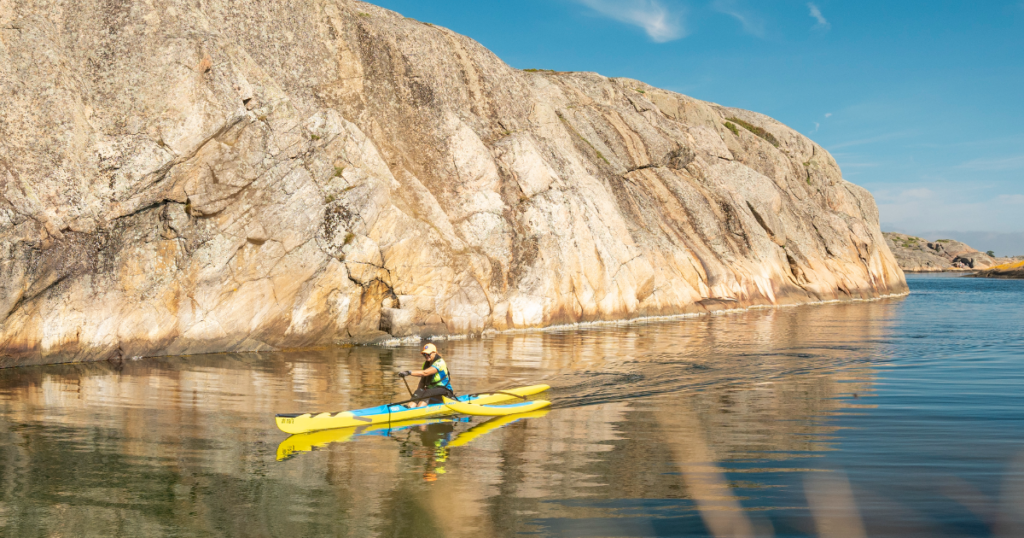
A few months before a race, I tweaked my back and had a decision to make. Keep building toward the races I’d been planning, or wait until I was more prepared.
I chose to keep going. As the next few months passed, it became clear what I was and wasn’t ready for.
I knew the race that I could handle: a downwind Pailolo channel, just over three hours, maybe three and a half. I did not feel prepared for a flat or upwind grind pushing four to five hours. Those aren’t the same race at all, and I knew that from past experience.
My preparation had limits. What I didn’t know was how hard it would be when those limits stopped being theoretical and became real in the middle of the race.
I had two races on the calendar for April — Maui to Molokai (26 miles across the Pailolo Channel – aka M2M) followed by the Ka’iwi Channel Relay (Molokai to Oahu 32 miles) the next weekend — and by March I was finally feeling good enough to start believing I could do M2M with the right conditions.
Leading into M2M, the forecast was all over the place. One forecast showed smoking conditions. Perfect. The other showed almost no wind. Every time I checked, it seemed to change again.
People kept saying, “Don’t worry about it, it’ll be fine.”
The problem was, I knew exactly why I was worried.
If the wind showed up, I was ready for the race I’d trained for. If it didn’t, it would be a much longer and harder day than I had prepared for. And the forecast kept suggesting both were possible.
This is the ocean, and the weather is going to weather. Conditions don’t care what race you trained for. They just show up.
During the race, I felt pretty decent for the first three hours, which makes sense because that was almost exactly the amount of time I had managed to train for. My fueling was good. There were occasional sections where the bumps turned on and for a moment I’d think maybe this was finally it, maybe the wind was arriving. But the wind never showed up, and the race was taking me a long time.
At the same time, I could feel my water pack getting lighter, and I was starting to notice pain building in my glute, something I’d never experienced before. At first it was just background noise — one of those things you negotiate with and try to mentally move around instead of fully acknowledging. But eventually it became impossible to ignore.
I got off the canoe at one point, hoping maybe I could loosen things up enough to keep going. But when I climbed back on, the pain became sharp. Crap, was this going to become an injury?
By then I was about four hours in, my water was basically gone, and a headwind was starting to build.
That’s when things shifted emotionally.
I’ve never pulled out of a race before, and I could feel my mind starting to spiral.
You knew you weren’t prepared for this version of the race. You know when you do a channel crossing you HAVE TO BE READY FOR ANYTHING.
So many of the channel crossings I’ve done over the years have been in less than ideal conditions. No wind. Sidewind. Headwind. Weird current. Why would I think this one would be any different?
The hardest part had very little to do with the physical pain or even the conditions. It was about who I thought I was supposed to be. Having a bad experience hits identity hard.
To all the rigid ideas I carry around about toughness, grit, persistence, and what it means to be “the kind of athlete” who finishes things. Or the kind of athlete who can handle anything. Or the kind of athlete that would never pull out of a race.
I could practically feel the cast of characters up in the balcony shaking their heads at me. I know most of those characters exist entirely in my own imagination, but still — they felt real in that moment.
My water was gone. My glute was getting worse. I had another race in a week. Could I push to the finish? Probably. But at what physical cost — and was it worth risking the Ka’iwi relay for it?
Eventually I called my husband, who had already finished the race, and he helped arrange support. Fortunately, an escort boat for a relay team was nearby and came to pick me and my canoe up safely. I was incredibly grateful, especially when I knew a couple of people on board.
I found out later that 17 people pulled out that day, including the race director, who told me afterward he had never seen conditions with a current like that in all his years of directing. That’s what shame does — it convinces you that you’re the only one. That everyone else handled it and you didn’t. It’s isolating by nature.
I was hard on myself afterwards. Harder than I needed to be. I felt embarrassed and questioned myself, replayed the decisions, and had to work through the disappointment that came with pulling out. I kept having to pull myself back from “you’re a bad athlete”, to, you did your best to prepare and unfortunately the day didn’t go how you wanted. And honestly? I hadn’t raced M2M in years for exactly that reason. I kept waiting until I felt ready enough. If I had kept waiting, I never would have shown up at the start line at all.
A week later, I was supposed to race the Ka’iwi relay and honestly that race became another exercise in adjusting to things not going according to plan. First our escort boat pulled out a few weeks before the race. Then my relay partner had to withdraw, so I joined an OC2 relay team that needed one more paddler instead. Then race morning arrived and the escort boat broke down ten miles away while we were getting ready to launch from the beach.
When the boat captain called, I tried to engineer a solution – no way was I not crossing the channel that day!
I was wrong. We loaded the canoe onto a race safety boat and spent the day watching everyone else paddle the channel. I was angry at first that I wasn’t out there. But underneath the anger was something else — sadness. Not just about that day, but about all the crossings I’d skipped over the years, waiting until I felt prepared enough. Now I’d finally shown up, twice, and neither race had gone to plan. Sitting on that safety boat watching everyone else paddle, I realized I still deeply wanted to be out there. I always had.
That felt important.
It reminded me that my purpose for paddling is joy. Not how I measure up.
I’m still grieving some of the changes — the recovery that used to come easily, the training I could push through with less consequence. And I’m still learning what it means to be this athlete, in this body, right now.
Persistence and grit still matter to me. But so does flexibility. Experience teaches you how to push, but it also teaches you when pushing too hard out of fear of what others think isn’t what your body needs. That’s the harder lesson.
I’m learning that adapting to reality is not weakness.
Sometimes it’s experience. Sometimes it’s maturity. Sometimes it’s self-acceptance.
And sometimes the strongest thing you can do is see your situation clearly and accept it and show up again anyway.
I went into this year with my eyes open. I knew what I was and wasn’t ready for. And I’d do it again.