
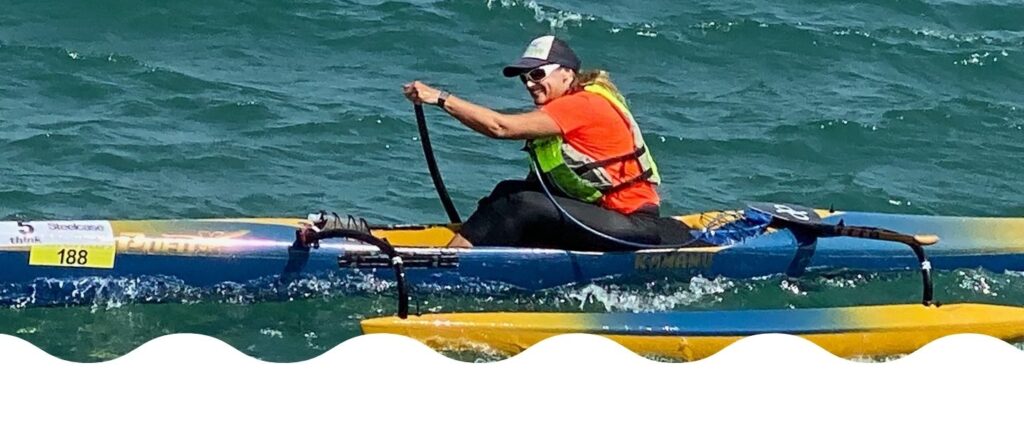
My last time trial didn’t go the way I wanted. Here’s how I deal with that.
At a recent time trial—a 30-minute blast in choppy water—I knew it wasn’t going to be my best day. I was stressed, rushed, underfed and still fatigued from our last training. I’m not as fast as I want to be this season. I was feeling frustrated, and that old inner voice—“not good enough”—started to creep in.
I could feel the negativity loop revving up.
I started mentally listing excuses. I was irritated about the course, annoyed we were time trialing again, looking to blame something—anything—for my discomfort.
The voice said, “You should be faster than this by now.” And I had to stop it.
Interrupting the loop
I had to interrupt the loop—and meet myself with perspective and self-compassion. Because letting that voice take over wasn’t helping me—it was hurting me.
What I realized was that I wasn’t just frustrated with my speed—I was frustrated with myself. I was struggling to accept where I was—with any kind of self-compassion.
Usually, when I don’t like how something’s going, the problem isn’t the result—it’s my reaction to it. Criticizing myself, or pushing that frustration onto others, doesn’t support growth.
So I take a breath, step back, and ask:
- What’s in my control?
- Can I accept where I’m at right now?
- And most importantly—can I separate performance from self-worth?
💡 It’s okay to be where I’m at.
This isn’t about perfection. It’s about progression.
Even with experience, it’s still vulnerable
I’ve been doing OC1 time trials for years. I’ve coached dozens of women through them.
And still—when it’s my turn to line up—I feel all the same things.
I overthink. I compare. I feel exposed, like I’m putting every vulnerability on display.
Time Trials Aren’t Perfect—But They’re Valuable
They’re not perfect, but they do reflect effort, technique, grit, and how we handle pressure.
No, they’re not totally fair. Some conditions favor certain paddlers.
OC6 skill doesn’t automatically translate to OC1, and vice versa.
Still—they show us something:
- How we’ve prepared
- How we respond
- Where we need to grow
You’re Not Alone
A lot of paddlers feel discouraged. Judged. Like they’re being measured against more skilled and experienced paddlers. I hear it from paddlers all the time:
“It’s not fair.”
“She can surf, I can’t”
“I train hard, but my time hasn’t improved.”
“I don’t know what to do to get better.”
OC1 Improvement Takes Time
It’s a common misconception that someone should be able to improve their OC1 paddling to match their fitness level in a few weeks or months. This is not true. Being a strong athlete isn’t the same as having OC1 skills.
OC1 is a complex sport. Building the skill of reading the water and developing the stroke technique takes time—years, not weeks.
So yes—it’s valid to feel frustrated when you aren’t able to measure up right away.
But when you shift the focus to yourself and what you can control, instead of comparing to others, there’s a huge opportunity for growth.
That’s why I do my best to treat OC1 time trials as a tool, not a test.
It’s not: “I’m not good enough?”
It’s: “What’s realistic for today?”
And: “What do I need to focus on tomorrow, next month, or next year?”
Because most of the time, the issue isn’t effort.
👉 It’s approach.
If you’ve been paddling consistently and aren’t getting faster, you probably don’t need to train harder—you need to train smarter.
In My Experience, improvement Comes Down to Three Things:
Technique. Skills. Training.
Each of these needs attention—and each should be developed and trained separately.
Technique = What your body is doing inside the stroke
- Using big muscles
- Rotating fully
- A strong clean catch
If you’re missing the connection to the water, you’re leaking power.
Great technique is learnable with a method that teaches how to engage your muscles and move your body in the most efficient way possible. (This is why I created the Precision Paddling technique training program, to address this issue.)
Skills = How you manage your canoe and use the water
- Getting off your ama
- Staying stable with your brace
- Adapting rate and power and steering to use the wave energy for speed
If you can’t adjust with the conditions, you will not go fast—even if you’re strong and fit.
This is why you have to treat skills development as its own category, because it’s not about feeling, it’s about learning specific skills to be fast in conditions and dedicating yourself to years of practice.
The bonus is that developing your OC1 skill set makes you a stronger OC6 paddler. 📖 I wrote an article about that, which you can read here → How OC1 Helps OC6
Training = Your engine
- Strength to move your canoe
- Conditioning to sustain effort
Many women under-train strength, don’t train for speed and spend too much time in the grey zone.
If you want results, you need high-intensity intervals and real strength work outside the canoe.
📖 Read → Why Strength Training Is Essential for Women OC1 Paddlers
📖 Read → What’s Missing from Women’s OC1 Training?
📖 Read → How to Fix 10 Common Endurance Training Mistakes
Train with Intention
If you lump everything into one session, you end up frustrated—and wondering why you’re not improving.
But when you separate them and follow a system, things become clear:
“This is what’s improving.”
“This is what I need to work on next.”
That’s when progress becomes measurable and improvements acheivable.
📖 Read → Sharpen Your OC1 Skills in Flat Water
Closing Thoughts
Time trials ask a lot: physically, mentally, emotionally.
But if you can zoom out and look at what they’re showing you, they become less about the number—and more about what’s next.
Not everything is in your control.
But many things are.
That’s where the real work happens.
Over time, effort in the right areas—technique, skills, training—adds up.
Not instantly. But it adds up.
So if your last time trial didn’t go the way you hoped, take a breath.
You’re not broken. You’re just in the messy middle—and it might be time to adjust your approach.
Systematically. With patience.
And with self-compassion.
That’s what progress looks like.