
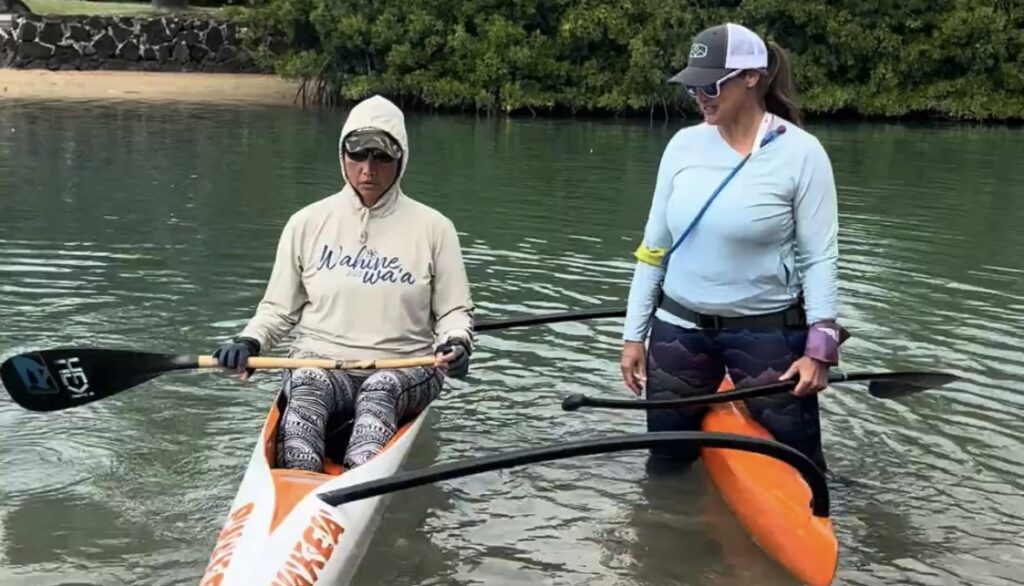
You’re trying — but nothing sticks
You’re thinking about your stroke. You’re trying. But nothing sticks.
Have you ever been told what to fix in your stroke…and tried to do it — but nothing really changed?
Well-intentioned coaches often explain the stroke, hoping their words will translate into better movement:
‘Top hand here.’
‘Lock in the bottom arm like this.’
‘Reach.’
And to be clear — this isn’t the coach’s fault.
They’re describing what a good stroke looks like.
But description isn’t the same as giving someone a way to change how they move and feel.
In a sport like OC1 — where you’re balancing, rotating, stabilizing, and trying to apply power all at once — that gap matters a lot.
So you get back in your canoe… and in your mind, you’re doing it.
You’re thinking about what you’ve been told to fix.
Where to reach. How to set the catch. What your top arm is doing.
Maybe a few strokes feel different.
But it’s a rare athlete that you can tell to “fix your catch”… and they can just do it.
You might get a few strokes that feel locked in… but you don’t know how you did it or how to repeat it.
And then you’re right back to how you were paddling before.
Not because you didn’t try — but because your body didn’t actually learn anything new.
Thinking isn’t training
Most paddlers think they’re working on technique when they focus on cues they’ve been given — reach, catch, top arm.
But nothing actually changes.
Because thinking about what to do isn’t the same as teaching your body how to do it.
Your body doesn’t learn through instructions — it learns through repetition, feel, and experience.
You can’t improve what you can’t feel.
Then you add intensity, your technique slips back to your usual stroke, and you keep going.
Stroke by stroke, technique gets worse as fatigue builds.
At that point, you’re not reinforcing good technique — you’re just paddling past the point where your best stroke exists.
And because you don’t have a way to reconnect to good movement during the session, all you’re left with is thinking about it.
It might hold together when everything is easy — but falls apart as soon as there’s speed, fatigue, or bumps.
Real technique work often means stopping before form breaks — not just paddling through it.
What you repeat becomes your stroke
When that happens — when your stroke breaks and you keep paddling — you start to fall back into whatever your default movement pattern is, often without even noticing it.
For some paddlers, that might look like losing posture or leaning on the ama.
And that becomes your default — because that’s what you’ve repeated.
Not just once, but across sessions, weeks, and months of paddling.
In a two-hour paddle at 60 strokes per minute, that’s over 7,000 strokes — repetitions of the same pattern.
Why most paddlers stay stuck
Most paddlers know their technique needs work.
But what they’re doing to improve it isn’t creating change.
They’re just repeating how they already paddle.
And over time, that’s how you paddle in races, in bumps, and whenever you try to go harder.
Because training technique isn’t about thinking harder or just trying to paddle better.
It’s about training differently.
A different way to train
If you want a structured way to rebuild your technique — through feel, repetition, and progression — Precision Paddling is where I teach this work in depth.
It’s a 10-week program designed to help you move better, apply power more cleanly, and hold your technique when it actually matters.
👉 Learn more about the program here.