
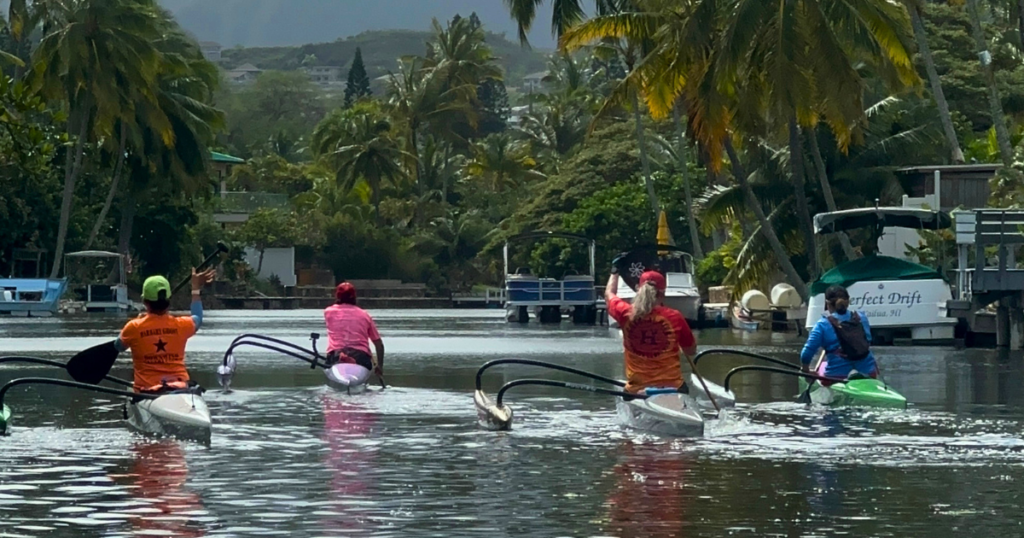
In my last endurance training session, I took 8,640 strokes.
In my last endurance training session, I took 8,640 strokes. Three hours alone, going up and down the canal in my OC-1. No music, no podcasts, no talking. Just attention to my body, one stroke at a time. That’s a lot of repetition.
And over that many strokes, my technique doesn’t stay the same. My attention drifts. I forget to sit up. My posture starts to collapse with fatigue. I stop using my legs. My bottom hand grip loosens and my top arm gets lazy and drops on the recovery.
You’ve probably felt some version of that. When things start to feel a little off, but you can’t quite tell why.
What happens over thousands of strokes
When I pay attention, I can feel when my stroke starts to change, and that’s when I have to catch it.
That’s the skill.
When I start to slump, when my shoulders creep up, when I stop using my legs, when my recovery gets sloppy, I start talking to myself: Sit up. Strong back. Use your legs. Engage your lats. Lift your top arm.
My form holds for a few minutes, or sometimes longer if I keep my attention on how I’m moving. Then I lose it, and I have to catch myself again. This is how it goes, over and over.
The skill most paddlers never develop
I can catch it because I know what my best strokes feel like, and I know what it feels like when I’m off.
I know what it feels like when my posture is strong, my lats are pulling, and my legs are working. When it all comes together, it feels connected, strong but effortless at the same time.
That doesn’t happen by accident.
It comes from spending time working on each detail of my stroke, over and over, until they’re familiar. So I can recognize when my technique falls apart and pull it back together in the moment.
Many paddlers can feel something change, but they don’t know how to stop it from getting worse. So they just paddle.
What most paddlers are actually doing
They go out, put in the time, and repeat the same stroke. They’re not really feeling what’s happening from one stroke to the next. When fatigue creeps in, they don’t have a way to fix it.
It just feels like paddling.
And nothing gets corrected.
And over time, those strokes add up.
Not better strokes.
The same ones, reinforced over and over, and often worse as the workout progresses.
That’s not the goal.
The real goal of training
The goal isn’t just to be fitter. Or to paddle more. Or to train harder.
The goal is also to develop your ability to hold your best technique for longer — under fatigue, at higher stroke rates, and when the water gets messy.
Not just for the first few strokes.
For all of them.
Because that’s what shows up when it counts. In racing, in intervals, in downwind.
What this actually requires
And this kind of training looks different.
You can’t just paddle and let your mind wander. You have to stay with your body. Feel what each stroke is doing, notice when something changes, and bring it back to your best stroke.
And then do it again. And again.
It’s not automatic. It’s not something that just happens because you’re putting in the time. It’s something you train.
Every stroke is reinforcing something.
Sometimes it’s your best stroke. Sometimes it’s not.
Over thousands of strokes, that adds up.
If you want a more structured way to work on this, that’s what I teach in Precision Paddling.